Fighting Games Are Fucked Up
I've been slowly trying to get into fighting games for the past year, mostly in preparation for Project L, now titled 2XKO (stupid name), Riot's upcoming game set in the League of Legends world.
It's been rough.
I've never felt so out of depth trying to properly learn a new video game genre before. And I've learnt to play a lot of genres - those bullet hells where you have to dodge thousands of projectiles for several minutes on end? Piece of piss, you can basically just memorise a few bullet patterns and then get through any game mostly fine. Speed-running Dark Souls? More like speed-running Baby Souls because the game is so easy a baby could play it. Rhythm games going at insane speeds requiring you to do at least 20 key presses per second? Also just pattern matching (and a bit of timing), I could do that shit with half the screen hidden. Doing sick aerials in Rocket League? Yeah, I DO THOSE.
But not fighting games. Fighting games are probably the most intimidating thing I've ever tried to learn. Like I know what I need to do to get better. I just don't see how it's possible.
Let's talk about frame data.
Pretty much all fighting games are capped at 60 frames per second (fps). If you're a PC gamer™, this at first glance sounds unacceptable. I normally play games at over 120 fps (1) (1) My monitor supports 144 fps, but I can accept losing 24 frames for better visuals if needed. so anything below 90 fps looks like a stop motion film to me. But having a fixed 60 fps is basically the only way for these games to work because their mechanics are designed and balanced around the frame rate.
So, frame data is a complete list of the inner workings of every move in a fighting game. (2) (2) This glossary by infil.net is probably the most useful tool I've ever used for a video game. It tells you how many frames a particular move takes to start (startup frames), how long it lasts (active frames), and how long the character takes to recover after the move is done (recovery frames). It also describes what the frame advantage/disadvantage is when the move hits or is blocked (I'll explain this later).
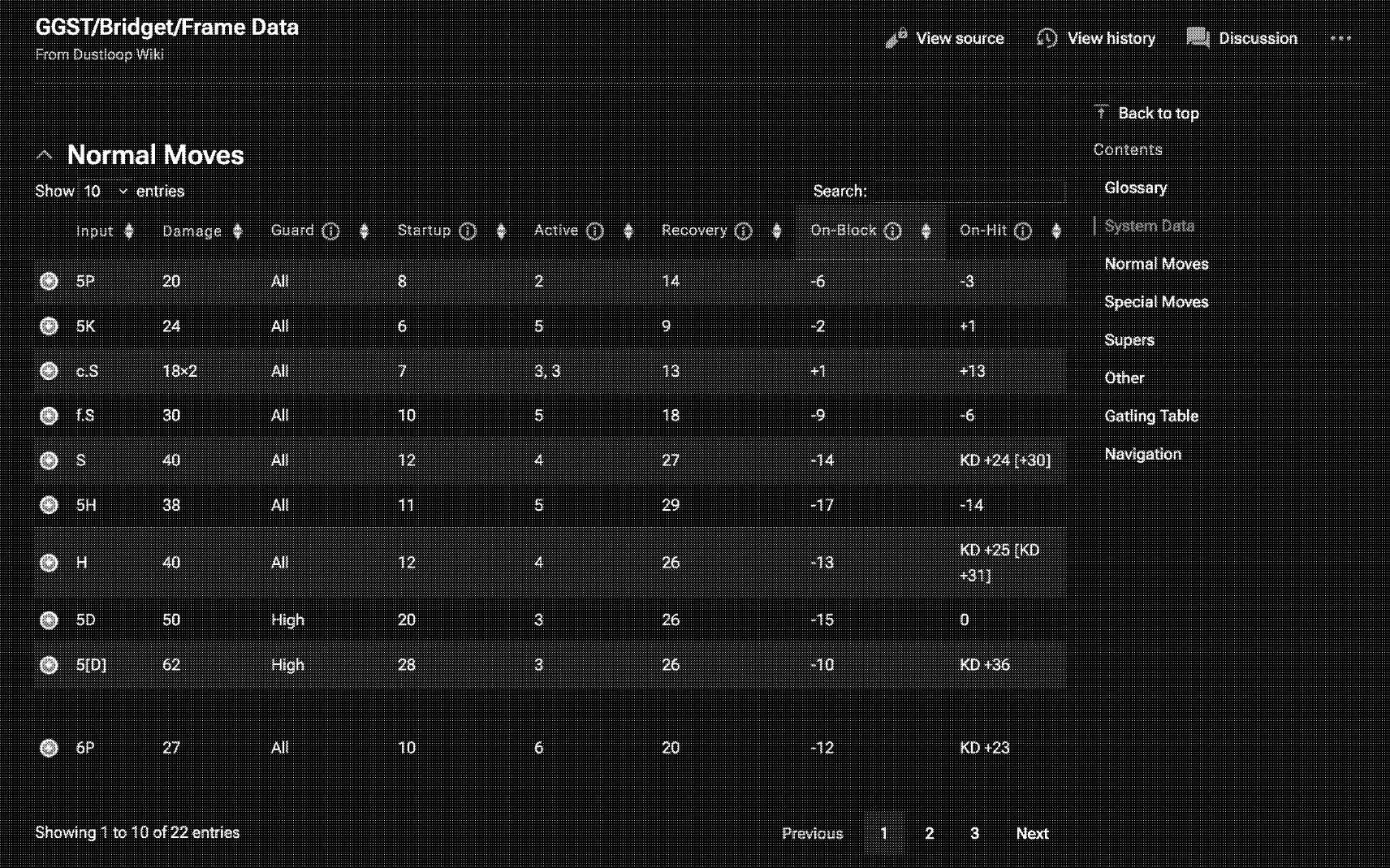
This is a small part of Dustloop's (3) (3) Dustloop is a wiki/information hub for games made by Arc System Works. frame data table for Bridget from Guilty Gear Strive.
Let's look at her 5P
(4)
(4)
We won't be getting into the different kinds of fighting game notation for inputs (another thing that makes them difficult to get into). But just know that 5P in Guilty Gear means "neutral punch", meaning you press the punch button without any directional controls, as opposed to something like 4P which is pressing the punch button while pressing on the left direction.
(the first row), which is a basic jab, typically one of the fastest and most basic attacks a character has, used for quick pokes or to interrupt an opponent's actions.
Skipping the damage and guard columns because they aren't important for this scenario, this attack has 8 startup frames, which means if the opponent pressed a button on the same frame as you but chose a move with longer startup frames (anything over 8), your move will "win", hit them and cancel their move by putting them into hitstun. (5) (5) The period of time when your character cannot perform any action after getting hit by an attack.
The active frames are the number of frames during which a move can actually hit an opponent. During this time, the attack's hurtbox (the area where it can make contact with an opponent) is active, when it collides with the opponents hitbox, the attack is registered. The length of this period can affect how easy it is to time a hit.
Recovery frames are the number of frames it takes for the character to return to a neutral state where they can perform another action. So her 5P has 14 recovery frames, which means after the attack has finished there are 14 frames where you can't do anything. This is the part of the attack that leaves you wide-open if you whiffed the move, so as long as the opponent uses a move with a startup under 14 frames, you can't block the attack.
Next is "on-block" and "on-hit". This determines "frame advantage", which is who recovers first when a move hits (on-hit, causing hitstun) or is blocked (on-block, causing blockstun). For Bridget's 5P, both "on-hit" and "on-block" are "minus" frames. This means you will recover from the move slower than the opponent recovers from hitstun or blockstun.
So being -6 on-block effectively means that if the opponent blocked the attack, you have a 6 frame disadvantage on your next move. And if you wanted to immediately do another 5P, that 8 frame startup essentially becomes 14 frames instead (8 + 6). Now the opponent only needs a move that has a startup of lower than 14 frames to beat you.
Conversely, when we say a move has "plus frames," it means that after executing the move, you can act again before the opponent can. This situation occurs when the move's hitstun lasts longer than the recovery time of the move. Bridget's 5K
(6)
(6)
"Neutral kick."
is +1 on-hit, so if the move hits (isn't blocked), Bridget has a 1 frame advantage. Now if you wanted to 5P immediately after again, your 8 frame startup becomes 7 frames (6 - 1).
(7)
(7)
To clarify, this is if your opponent is also doing a move immediately after, the attack startup doesn't literally become faster, it's relative to what your opponent does.
To beginners, fighting games appear to be continuous, action-packed exchanges between players. But what's interesting is that when analysed through the lens of frame data and the concept of plus and minus frames, it becomes apparent that fighting games actually involve a turn-based system hidden within their real-time mechanics.
When you execute a move that leaves them with frame advantage, you earn the "turn" to act before their opponent can react, allowing you to continue your offensive or apply pressure. On the other hand, being at a frame disadvantage means it's your opponent's turn to take action, potentially putting you on the defensive.
An important part of this is the "neutral game", where both players are neither distinctly on offence nor defence, which involves a tactical battle for the opportunity to take the turn. Players often use moves that are safe on block—those that leave the player at a neutral or slight disadvantage—to probe the opponent's defences without overcommitting, aiming to create an opening or elicit a mistake that leads to gaining frame advantage.
This turn-based dynamic creates serious strategic complexity. You need to be able to balance executing combos and defence with managing when to attack or defend, leveraging frame data to control the flow. High-level play involves using moves that are safe or alter frame advantage, thus dictating the pace. This system, blending turn-based strategy with real-time action, demands foresight and tactical planning, almost akin to traditional turn-based games but at a literally frame-perfect pace.
Dark Souls is another game that has this "turn based real-time" gameplay dynamic, but it's actually one of the things I hate about Souls-like games in general. I don't like having to wait for my turn, it's boring and just involves pressing the roll button at the right time. Fighting games solve this by speeding the turns up to only last a few seconds at most, and adding the additional complication of mind-games against your opponent. (8) (8) Something that isn't done that well in any Souls-like PvP mode.
Now I don't think you need to memorise the frame data for every move every character has in a game, but you should at least memorise it for the moves your character does.
But still, it's fucking nuts.
I've never seen a game before where frames are this important.
In fact, they're so important that most modern fighting games these days include an indicator for online matches to tell you if your opponent is using a wired (Ethernet) or wireless (Wi-Fi) connection so you can discriminate against Wi-Fi users and decline having a match with them. THIS IS BUILT INTO THE GAME. IT WANTS YOU TO BE RACIST AGAINST WIFI USERS.
Okay, let's take a step back. Why do this?
For online play, modern fighting games use what's called "rollback netcode", which predicts the players' actions based on their most recent inputs, allowing the game to continue without waiting for the latest data from the other player. This prediction helps keep the game feeling responsive, even over imperfect Internet connections.
When new input data arrives from the other player and it doesn't match the prediction, the netcode "rolls back" to the correct state and updates the game. Normally, this correction happens so quickly that players often don't notice.
Basically, rollback netcode significantly reduces the perception of lag, so that players can execute moves and see reactions with minimal delay.
I recommend watching "Analysis: Why Rollback Netcode Is Better" by Core-A Gaming for a better explanation.
The problem with Wi-Fi connections is that they're less stable and more prone to interference than wired connections. This instability can lead to fluctuating ping times and packet loss.
Fighting games are games where every frame matters which means every frame needs to be synced across all players for the game to function correctly.
The inconsistencies of Wi-Fi generally lead to more frequent and noticeable rollbacks. I didn't believe it at first, that it would matter that much, but like… it does, holy shit it REALLY does. I don't like playing against Wi-Fi users, I decline to fight them now.
I've NEVER had to do this before in any other game, it's fucked up.
These games are fucked.
I love them.
Epilogue
League of Legends ruined my life (9) (9) Imagine how successful I could be if I didn't waste almost all of my high school years playing that game and was studying instead ;( and I quit that game in 2016, so I don't know anything about a lot of the characters now. But here's a list of characters I want in 2XKO (stupid name):
- Teemo
- Gnar
- Kennen
- Kha'Zix
- Teemo
- Ezreal
- Zed
- Lulu
- TEEMO
- Thresh
- YOU BETTER PUT TEEMO IN THE GAME YOU FUCKING COWARDS
This is basically just the list of characters I mained. (10) (10) And I've just realised it's mostly men, which is certainly interesting in some way. And very different to the characters I choose nowadays.
Also they should add Tracer from Overwatch as a guest character thank you for coming to my TED Talk.